
Trauma Informed Education

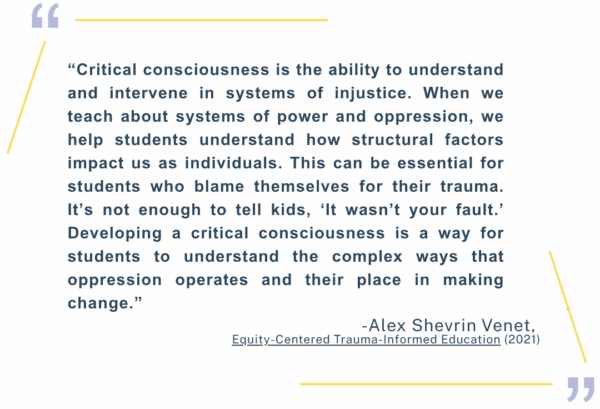
“Critical consciousness is the ability to understand and intervene in systems of injustice. When we teach about systems of power and oppression, we help students understand how structural factors impact us as individuals. This can be essential for students who blame themselves for their trauma. It’s not enough to tell kids, ‘It wasn’t your fault.’ Developing a critical consciousness is a way for students to understand the complex ways that oppression operates and their place in making change.” Alex Shevrin Venet, Equity-Centered Trauma-Informed Education (2021)
3
“Critical consciousness is the ability to understand and intervene in systems of injustice. When we teach about systems of power and oppression, we help students understand how structural factors impact us as individuals. This can be essential for students who blame themselves for their trauma. It’s not enough to tell kids, ‘It wasn’t your fault.’ Developing a critical consciousness is a way for students to understand the complex ways that oppression operates and their place in making change.” Alex Shevrin Venet, Equity-Centered Trauma-Informed Education (2021)

Trauma-informed education endeavors to create learning environments that are safe and nurturing, unlocking access to learning for students and adults who have experienced trauma. One important consideration in trauma-informed practices is that schools are sometimes where harm occurs. As we seek to build safer, more inclusive educational spaces, it is critical that we sharpen our ability to recognize and address the harm students and adults experience. The four priorities of equity-centered, trauma-informed education are: predictability, flexibility, connection, and empowerment (Venet, 2021). These four pillars have been incorporated throughout the Integrated Curriculum – via the organization of information, the intentional essential questions, and action-oriented sample assessments – to support an equity-centered, trauma-informed lens in curriculum development.

Learning Progression Playlist

Defining and Understanding Key Ideas and Concepts

📝Read: Understanding Trauma-Informed Education by Mathew Portell

📝Read: ‘Trauma Is a Lens, Not a Label’: How Schools Can Support All Students by Nimah Gobir

Weaving Ideas and Concepts Together

📝Read: Why Our Trauma-Informed Teaching Must Be More Culturally Responsive by Helen Thomas

🎤Listen or 📝Read: Unpacking Trauma-Informed Teaching, Cult of Pedagogy with Alex Shevrin Venet (44:00)

📺Watch: 3 Trauma-Informed Practices Backed By Science, Edutopia

Complex Application of the Key Concepts

📝Read: Pathologizing Anger in Schools by Dr. Rhiannon Kim

📝Read: Decarceration Begins with School Discipline Reform by Anthony Carwright

Strands of ICVE

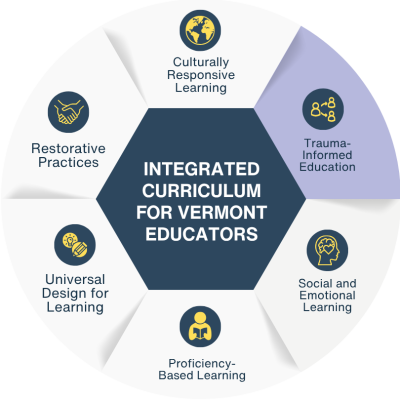
Click on any of the boxes below to explore the Integrated Curriculum for Vermont Educators (ICVE) strands.

Integrated Curriculum

What is the Integrated Curriculum and how can I use it?

Culturally Responsive Learning

How do I integrate Culturally Responsive and Sustaining Education in my practice?

Trauma-Informed Education

How do I integrate Trauma-Informed Education in my practice?

Social and Emotional Learning

How do I integrate Social and Emotional Learning in my practice?

Proficiency-Based Learning

How do I integrate Proficiency-Based learning in my practice?

Universal Design for Learning

How do I integrate Universal Design for Learning in my practice?

Restorative Practices

How do I integrate Restorative Practices in my practice?

Integrated Curriculum

What is the Integrated Curriculum and how can I use it?

Culturally Responsive Learning

How do I integrate Culturally Responsive and Sustaining Education in my practice?

Trauma-Informed Education

How do I integrate Trauma-Informed Education in my practice?

Social and Emotional Learning

How do I integrate Social and Emotional Learning in my practice?

Proficiency-Based Learning

How do I integrate Proficiency-Based learning in my practice?

Universal Design for Learning

How do I integrate Universal Design for Learning in my practice?

Restorative Practices

How do I integrate Restorative Practices in my practice?