

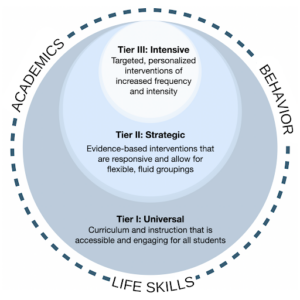
Multi-tiered systems of support (MTSS) is a framework designed to provide individualized support to students to ensure that they are able to learn and grow academically, socially, and behaviorally.
The three tiers of MTSS work together as follows:
- Tier one is universal: It is curriculum and instruction that is accessible, engaging, and standards-aligned. Materials are reflective of students and the global community.
- Tier two is strategic: Evidence-based interventions that are responsive and integrated into classroom practice or take place in small, fluid groupings.
- Tier three is intensive: Targeted interventions that are applied with increased intensity.
As with any system, however, if schools do not center the perspectives and experiences of those most affected, MTSS can become a system of removal that reinforces student perception of poor performance, resulting in lower self-efficacy beliefs and disengagement.
Katie’s Story
In an exit interview with a student from a school community in Maine, Katie, a senior, discussed her experiences of being removed from her peers during math instruction to receive additional support. She recalled being removed from STEM activities that her friends and peers were able to participate in. By the time she entered high school, she believed she was “not good at math” and signed up for the most remedial classes available. Her grades were poor. She struggled to complete her homework.
If the story stopped here, it would be one thing. Fortunately, Katie’s story continues.
In high school, she had a teacher who made himself available for office hours, who followed up with her in targeted ways in class, and who set concrete goals and provided support. It was his baseline for every learner. This teacher, she said, changed her life. Math was hard, but she began to see that she could do hard things. By the time of the exit interview, she was on her way to college.
Her advice to teachers: “Be careful of how you label your students. Kids always know who believes in them.”
Katie isn’t alone. John Hattie’s research found that teacher perception of student ability and collective teacher efficacy were highly correlated with student achievement.
The Multi-Tiered Systems of Support Toolkit
GSP’s education experts developed the MTSS toolkit to provide a clear entry point for educators seeking to explore this comprehensive framework. It is composed of three distinct sections, designed to support educators as they lay the foundation for student-centered Multi-Tiered System of Supports (MTSS).
 MTSS Guiding Beliefs
One of the questions GSP Senior Associates ask when working with school partners, regardless of the specific work, is, “What underlying beliefs are necessary to create conditions for each student to learn and grow? How can we ensure students and families are honored? That students and educators are able to learn and grow? That our systems are designed with those most excluded at the center?”
As educators, it’s essential to immerse ourselves in these understandings and beliefs in conversations about student learning and growth. In our work with school partners across New England, we’ve identified four guiding beliefs that help create the conditions for student-centered MTSS:
- All means all.
- In addition to, not instead of.
- Learning is fluid and requires flexibility.
- Together we are stronger.
The Guiding Beliefs tool expands on these ideas, helping educators stay grounded in the purpose of MTSS, which is to help all students find success and belonging in schools.
 MTSS Pulse Check
The authentic use of the pulse check will help teams determine next steps to create long-lasting, proactive strategies that encourage school community members to engage with one another, ultimately leading to systems-level changes that ensure all students enter a safe, welcoming, and effective learning environment.
 MTSS Research and Resources Guide
The Research and Resources Guide includes articles, book recommendations, research, reports, videos, and infographics curated by GSP Senior Associates. These materials can be used to design professional learning for staff or as an anchor piece for professional learning groups or communities to deepen your team’s collective understanding.
Learn More – For Free
If you’d like to learn more about MTSS tools and resources, as well as hear from a GSP partner on implementing MTSS systemically, we encourage you to sign up for our MTSS Summer Workshop, Unlocking the Power of MTSS. This thorough two-day workshop will provide educators with a deeper understanding of MTSS, actionable strategies to support MTSS implementation, and provide educators with an opportunity to ask any lingering questions about this innovative framework. Participants will leave with a plan for implementing a more dynamic and inclusive learning environment for all students.