
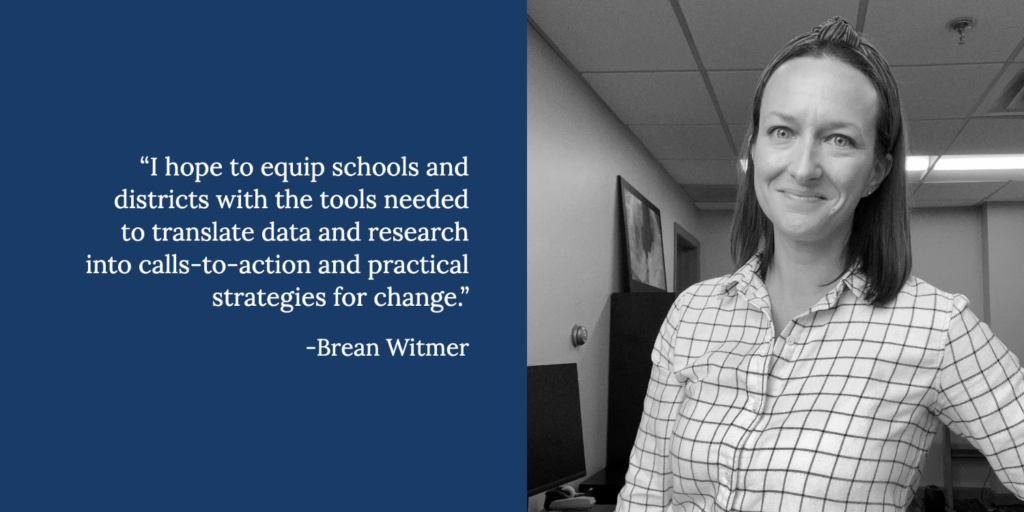
Brean Witmer is our new director of research and evaluation. We’re proud to share some of her story below.
Tell us a little about yourself.
My path to research and evaluation took a somewhat winding route. While focusing my graduate studies on child and family policy, I was fortunate enough to have a mentor that focused her career on program evaluation – specifically, how evaluation can be integrated into every stage of program conceptualization, design, and implementation, to make a sustained impact on communities. Although much of what I was learning and executing during this time was around community-based research and policy, I inherited her commitment to evaluation and its role in meaningful programs and policies that are reflective of the unique assets and needs of each community. For the following decade, I dedicated much of my work to the translation of data, research, and evaluation into programs and policies that were aimed at realistically helping communities move the needle and meet their goals.
What do you hope to accomplish in your new role?
As the new director of research and evaluation, I hope to equip schools and districts with the tools needed to translate data and research into calls-to-action and practical strategies for change. My goal is for partner schools and districts to have a deeper understanding, through data, of what works well in their school community, what could work better, and how data can support them in meeting that goal. I also hope to work as a thought partner alongside all senior associates at the Great Schools Partnership (GSP) to explore new and innovative ways that quantitative and street data can be leveraged synchronously while working toward educational excellence and equity.
What do you see as one of the biggest barriers holding us back from realizing greater equity in learning?
Although certainly not the only barrier, I believe that our system’s narrow definition and measurement of student success propagates inequities. When success is understood more holistically, beyond simply numeracy, literacy, and college enrollment, learning environments and outcomes will become more just, equitable, and student-centered.
Taking this leap requires systemic shifts in how we value instruction and outcomes, and requires data collection that is inclusive of constructs around social emotional health, school climate, the wellbeing of educators and administrators, caregiver engagement, student confidence and self-efficacy, skill proficiency, and more. Leveraging data to understand learning and student success more holistically allows us to unveil inequities that lay deeper – those that may not be visible when measuring for the standard definition of student success. Yet it’s this unveiling of inequities that’s the first step to dismantling them.
What role do you see research and evaluation playing in redesigning public education?
I believe that research and evaluation is critical at every stage of the process. From conducting initial needs assessments and policy analyses in order to identify areas of inequities and evaluating existing practices and organization designs, to developing customized approaches and interventions, analyzing implementation and outcomes, refining, and continually monitoring for enhancements – research and evaluation is a continuous cycle. Embedding this cycle into the on-the-ground work that districts and schools are doing to create more equitable learning communities for their students and families helps ensure greater success in the long run.