From the Blog

Can a Dance Video Be a Powerful Pedagogical Tool?

by Erica Wallstrom 

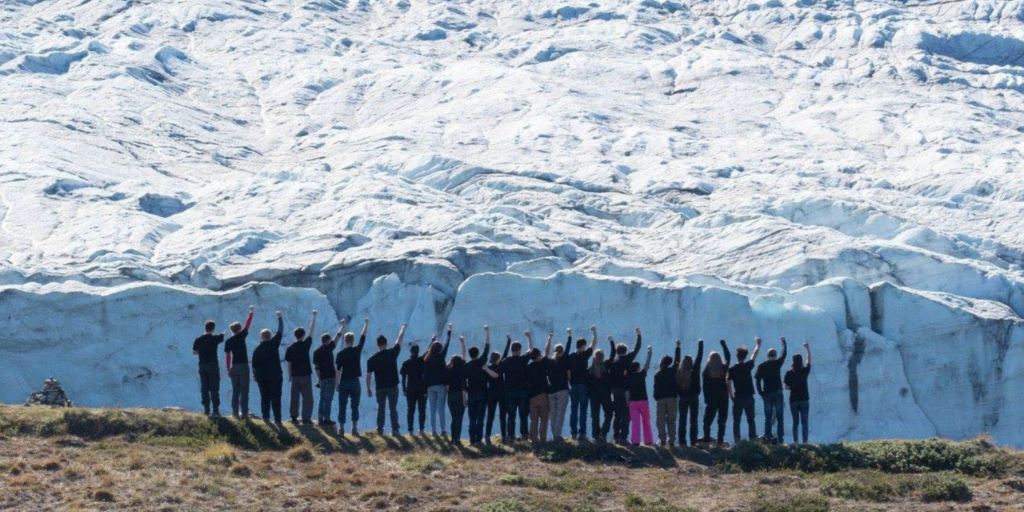
A group of people stand on grassy ground facing a large glacier, raising one arm in the air as if filming a dance video. Everyone is dressed in dark clothing except one person in bright pink pants. The glacier dominates the background.

Erica Wallstrom is a newly hired senior associate at the Great Schools Partnership. We’re proud to share her first blog for our organization

Social media sensations like TikTok provide an endless library of brief, stylized dance videos that will quickly consume any spare moments one might have. I confess that I am easily drawn to these 30 seconds of digital eye candy, but better than remaining a passive observer, I appreciate the benefits of creating such classics for myself. I believe that producing a collaborative dance video is a powerful practice that could literally bring world peace—OK, maybe a stretch, but wouldn’t it be such a hopeful sign of diplomacy to see Presidents Biden and Putin flossing together, even if for just a moment?

Beyond the White House and Kremlin, I believe that the dance video is a meaningful pedagogical tool that can foster positive learning environments. I have experienced this strategy’s potential each year when our Joint Science Education Project (JSEP) students produce our group’s dance video. JESP is a collaborative, international program that brings together students from Greenland, Denmark, the Faroe Islands, and the U.S. to conduct polar field science in Greenland. As educators, we work to build cultural connections, conduct meaningful polar science and create an annual dance video. In the moments in between traveling to the ice sheet, hearing from science experts, and collecting data, we squeeze in recordings of team members strutting their stuff with the tundra as our natural backdrop. The culminating dance videos could easily be classified as a fluffy, feel good filler that is not at the heart of our program’s purpose and learning; but I would argue it is quite the opposite. The creation process of these videos is one of our many tools that we use very deliberately to build a strong, supportive, inclusive, and engaging learning environment.

Dance Videos Build Relationships

Educators know the importance of establishing meaningful relationships with colleagues, families, and especially students. At GSP, developing trusting relationships is a core tenant and at the heart of what we do and advocate for in education. While there are many different strategies for fostering relationships that are meaningful, supportive, and safe, ultimately it requires a willingness to explore, discover, and share authentic connections between people. These affinities are strengthened as group members find commonalities, engage with one another, and show vulnerability. It is easy at JSEP to rattle off what on the surface makes connections challenging: we speak different languages, represent different countries, and have varied experiences with conducting science. Left unchecked, it is easy for students (and adults) to gravitate toward peers from their home country; however, we frame the dance video as a low-stakes endeavor that we will complete together as a team. With teachers modeling a willingness to actively participate despite awkwardness, students quickly follow. Dancing helps to reduce the very real social barriers that exist because we do not need a common language, culture, or history to move our bodies to the music and work together on a common goal.

Dance Videos Encapsulate a Sense of Belonging

If you watch one of our videos, at some point you will see a clip including every person on our team. Depending on the individual’s personality or dancing expertise, there may be choreographed routines and acrobatic feats; alternatively, there are subtle waves, movements, and snaps. There is no need for rhythm, experience, or perfection, just involvement at whatever level a person feels comfortable. We make sure to orchestrate both large and small group portions as well as solos. Additionally, the group determines the song that they would like to have as their anthem and student volunteers complete the editing. We always end our three-week JSEP experience with a celebration including the unveiling of the video. Predictably, students erupt into applause and cheers when the music stops. Then there is usually a quiet that falls over the group; finally, one person will tentatively request that we watch it again. Their connection to the performance is because the production was a process dependent on the entire team. A video that generates such natural emotion is because of the collective enthusiasm, willingness, and collaboration. Ultimately, the final product is a visual synopsis of the group showcasing the interconnectedness of the individual participants.

Dance Videos Bring Joy

In between watching TikTok videos, I saw a meme claiming a child laughs 300 times a day while an adult laughs only 17 times a day. Regardless of the statistical accuracy of this statement, the world can always use more laughter, joy, and happiness. This is even more relevant as we enter our third year of coping with a pandemic. Creating a dance video inevitably brings fun to the moment, and also provides an archive of that feeling and sentiment. When I feel burnt out or overwhelmed and need a reminder that my life is filled with happiness and fun, I use our YouTube channel as a way to transport myself there. I challenge people to find one of our videos where students are not laughing and smiling. I double dare you to try watching one of our videos without cracking a smile or feeling at least a twinge of happiness yourself.

Dance Videos Are a Tool

Our JSEP team has found dance videos to be very helpful in building a sense of community in a short amount of time. As educators, we need to embrace the essence of the dance video and identify our own platforms that we can incorporate into our daily practice. I challenge teachers to step back from the pressures of coverage and content to consider ways that their students can express themselves in creative and physical ways. We need to structure opportunities where students that have been separate, and perhaps isolated, can come together with a common purpose. And we need to intentionally embed fun, joy, and laughter in our curriculum for everyone—including ourselves.