
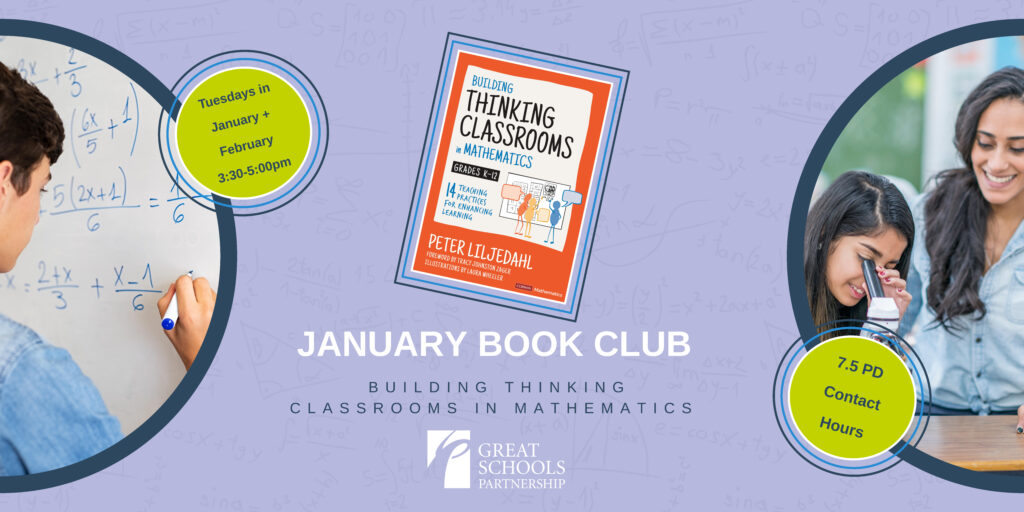
A sneak peek at what GSP will cover in our Virtual Book Club series on Peter Liljedahl’s Building Thinking Classrooms in Mathematics.
What is a “thinking” classroom?
A thinking classroom is one where students, not the teacher, are doing the intellectual heavy lifting. In a thinking classroom, students actively engage in problem-solving, discuss ideas, and make sense of mathematics together. Teachers move from being the source of knowledge to architects of thinking, implementing practices that make student thinking visible and valued through collaboration and problem-solving.
Implementing Building Thinking Classrooms in Mathematics
The first three practices Peter Liljedahl outlines in Building Thinking Classrooms in Mathematics are powerful and easy to implement right away:
- Start with a good problem: Liljedahl emphasizes the importance of beginning with a task that gets students thinking—often a non-curricular problem to break down barriers and build confidence. Once students are in the habit of thinking, teachers can move into rich curricular tasks.
- Use visibly random groups: Assigning students to groups randomly (and visibly so) ensures a mix of voices and reduces status issues. This can be done with tools like playing cards, random name generators, or just counting off. When students know the groupings are truly random, they’re more likely to collaborate with a wider range of peers.
- Have students work on vertical non-permanent surfaces (VNPS): Getting students out of their seats and working on whiteboards, windows, or even laminated sheets taped to the wall increases participation and makes thinking visible. Liljedahl’s research shows that when students work on vertical dry-erase surfaces, they write sooner, revise more often, and engage more deeply.
Designing the Right Task for a Thinking Classroom
Designing the right task for your students is one of the most critical elements of building thinking-classrooms in mathematics. The right task invites students into mathematics and gives them a reason to engage. A well-chosen task, or math problem, tells a story—even better, it tells their story.
When students can see themselves in mathematics – when the context is relevant or personally meaningful – they’re more likely to invest in the problem-solving process. Student-centered thinking classrooms begin with purposeful tasks that spark curiosity and promote ownership.

The Benefits of Building a Thinking Classroom in Mathematics
When students are consistently placed in situations that require collaboration, communication, and perseverance, such as thinking classrooms, they develop not just mathematical skills but also agency and confidence. Liljedahl reminds us that students do many things in a classroom, some of which involve thinking. Our job is to maximize the thinking. His practices create space for students to wrestle with ideas, take risks, and learn from each other.
Engaged Problem-Solving and Collaboration in Thinking Classrooms
In a thinking classroom, you’ll see students standing, moving, pointing, and talking—often all at once. In thinking classrooms, specifically in mathematics, you’ll hear math conversations: questions, debates, peer explanations, and even disagreements (the productive kind). Students will try multiple approaches, correct each other, and push for clarity. Most importantly, you’ll see students owning the learning in a thinking classroom.
What can educators expect from the GSP Thinking Classroom Book Club?
Educators can expect a supportive, collaborative space to explore and reflect on the core practices from Building Thinking Classrooms. Each session will highlight key takeaways from the book, provide opportunities to share classroom experiences, and help participants plan how to implement the strategies in their own settings.
Whether you’re brand new to Liljedahl’s work or have already started experimenting, the book group will offer practical ideas, thoughtful discussion, and inspiration to create more student-centered, thinking-driven math classrooms.
Educators can expect a supportive, collaborative space to explore and reflect on the core practices from Building Thinking Classrooms. Each session will highlight key takeaways from the book, provide opportunities to share classroom experiences, and help participants plan how to implement the strategies in their own settings. Whether you’re brand new to Liljedahl’s work or have already started experimenting, the book group will offer practical ideas, thoughtful discussion, and inspiration to create more student-centered, thinking-driven math classrooms.

Sign up for our Virtual Bookclub – Building Thinking Classrooms in Mathematics by Peter Liljedahl to continue learning about the small shifts that will make a big difference in your mathematics practice.
- 00Days
- 00Hours
- 00Minutes
- 00Seconds