By: Darthula Mathews, and Erin Conley

Education leaders increasingly recognize that a diverse educator workforce is not just a matter of equity; it’s a matter of impact. All students benefit when they learn from educators who reflect the diversity of the world and who view students and families as assets.
Dr. Lamirra Hood-Stewart is a Connecticut educator and leader who has spent over 20 years living and working in the state. From home daycare to leading clinical day schools, her journey is shaped by experience, reflection, and a deep commitment to equity. Her story, rooted in both triumph and challenge, offers a powerful lens into the significance of representation and how schools and school systems can move from intention to action.

The Interview
Question 1: Can you share your journey into education and leadership? How has your identity shaped that journey?
My path into education began with caring for my own kids and supporting families. I ran a home daycare in New York and later supported military families in Maine. I transitioned from volunteering with Head Start to a paid position, and eventually earned my master’s in special education and my doctorate in educational leadership. It wasn’t just career growth; I saw how my kids, especially my daughter, were the only ones who looked like them in many classrooms. That motivated me to stay in spaces where I could make a difference for kids who, like my children and like me, needed someone to understand them and see their worth.
Question 2: What are some of the challenges you faced as a BIPOC educator? How did you navigate them?
It was hard to realize that standardized tests didn’t account for my students’ experiences, or mine. I gave a cognitive test asking, “What is the cow doing in the picture?” and the student answered, “eating grass.” He lost points because the “correct” answer was “grazing.” That shook me. I was educated, but I would’ve answered the same way. Beyond standardized testing, I often felt unheard, especially as a young Black woman among veteran white educators. I’ve learned to speak up, stay curious rather than confrontational, and remain rooted in my purpose.
Question 3: What was it like as a parent raising BIPOC children in a less diverse community?
I thought a “better” school district would offer more opportunities, not realizing the emotional toll it would have on my children. My daughter was ridiculed for her skin color, called “Black as a Sharpie,” and developed body dysmorphia from beauty standards that excluded her as the only one like her in our community. One year, an incident made the news: white students chased a Black student with a noose, and my daughter was the only one to report it. That broke my heart. I had chosen academics over cultural belonging. Though my children found strength, I still wonder if staying in a more diverse community would have been better. Their experiences shape how I support my students today.
Question 4: How has the presence/absence of BIPOC educators impacted your sense of identity and belonging?
While I had a diverse peer group growing up, I rarely had teachers who looked like me. In my lived experience, that missing presence influenced how I was perceived and what I was encouraged to pursue. A school counselor once told me, “No, you want to be a midwife” instead of the OBGYN doctor I had aspired to be. This made me question my worth. That lack of representation pushed me to become the role model I didn’t have. When I became a principal and experienced students of color cheering for my promotion, like I’d won a championship, I understood why. It reminded me how much representation matters, for belonging and for belief in what’s possible.
Question 5: What role does representation play in shaping school culture and experience for all students?
Representation builds a culture where all students feel seen and safe. When staff reflect student and world diversity, it promotes empathy and psychological safety. Kids realize they can achieve more because they see people like them in their immediate sphere and around the globe in positions of influence. Diversity in staff also brings broader perspectives, which benefits every student and the larger school community.
Question 6: What actions can school systems take to recruit, support, and retain educators of color?
To keep BIPOC educators, we must care about their well-being—personally and professionally. The emotional labor is heavy, especially in communities affected by trauma. Recruiting is hard because many don’t see teaching as viable or respected. Support must include training in anti-bias, cultural competence, and how to recognize the signs and impact of trauma. Educators need tools to understand and meet students’ complex needs with compassion and provide mutual support to their colleagues. Building communities of care and offering growth opportunities are key for both students and educators.
Question 7: What advice would you give to aspiring BIPOC educators considering leadership roles?
Be confident in who you are and speak up; your perspective is needed, even when others don’t see it. Speak up. Share your story, not because it’s your job to educate everyone, but because your truth is powerful. Find your people, those who affirm and support you, and don’t let anyone dim your light. Your presence creates change and opens doors for others.
Diversifying the Educator Workforce in Connecticut and Beyond
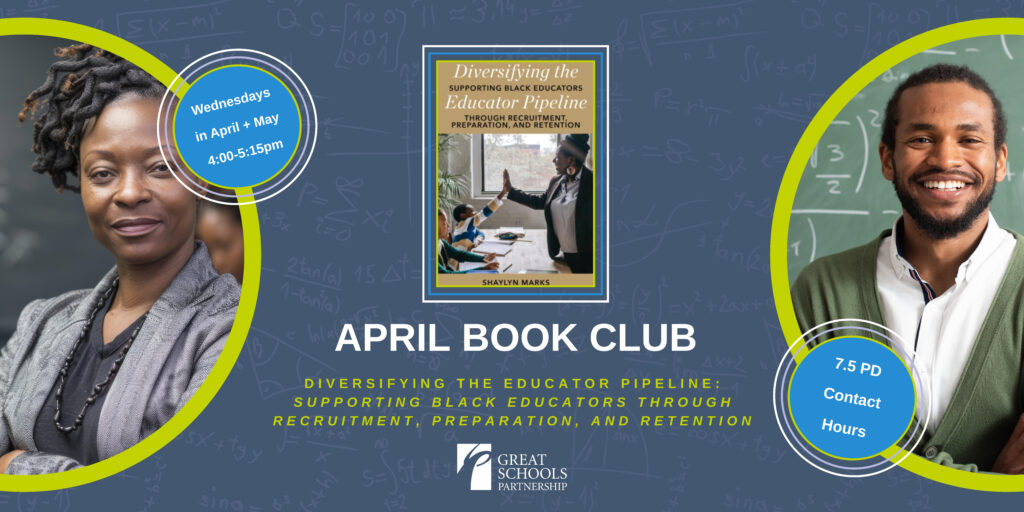
The Great School’s Partnership is dedicated to sustaining a diverse educator workforce across New England. If you would like to learn more about how you too can join this work, sign up for our GSP Book Club: Diversifying the Educator Pipeline, April 15 – May 06, 2026. Follow the link below for details and registration.