
In an effort to equip educators with practical strategies for implementing anti-racism in the classroom while supporting their social-emotional well-being, CARE (Coalition for Anti-Racism and Equity) and the Great Schools Partnership are launching an impactful professional development series. We sat down with Ralph Saint-Louis, one of the organizers, to discuss the series, its significance, and what participants can expect. 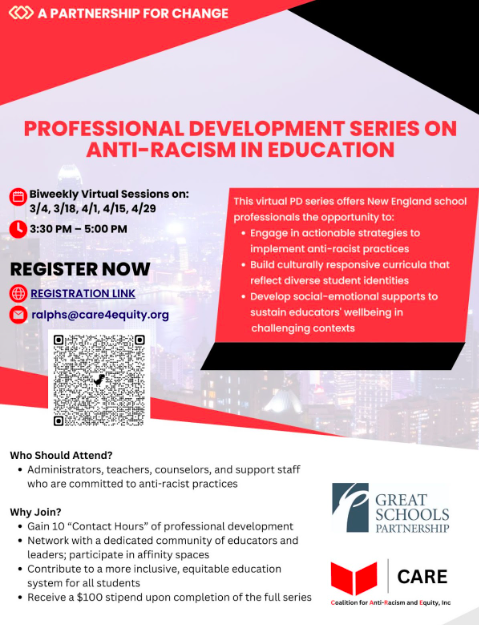
Q: What is this series about?
This is a five-part professional development series about equipping school staff at all levels with the tools to take meaningful action toward anti-racism in education. This work goes beyond just recognizing systemic inequities. It’s about actively dismantling them to create schools where all students and staff feel seen, valued, and empowered.
Too often, the responsibility of creating inclusive and equitable learning environments is placed on individuals without the institutional support, training, resources, or even the time and capacity to sustain it. Yet, school staff remain deeply committed to supporting the whole child, often navigating these systemic challenges with what appears to be declining public support. This series provides concrete, practical strategies for embedding anti-racism into curriculum, policies, and school culture, addressing implicit bias, and advocating for structural change. At the same time, we recognize the emotional toll of this work and the need to prioritize the well-being of school staff who are leading these efforts.
Spanning five interactive workshops and offline reflection activities, and totaling 10 hours of professional development, this series is designed to move beyond discussion and into actionable solutions that transform schools at every level. Participants who complete the full series will receive a $100 stipend. A step toward acknowledging the labor, commitment, and expertise that school staff bring to this critical work.
The workshop schedule is:
- March 4: Workshop 1 – Panel Discussion: The Importance of Anti-Racism in Education
- March 18: Workshop 2 – Culturally Responsive Teaching Practices
- April 1: Workshop 3 – Understanding and Addressing Implicit Bias in the Classroom
- April 15: Workshop 4 – Social-Emotional Support for Educators
- April 29: Workshop 5 – Small Acts of Resistance: A Culminating Experience
Q: Why does this series feel timely?
Initially, this workshop series was created to provide resources, strategies, and support to school staff invested in creating spaces where people feel affirmed, validated, and able to do their best work. Given the pandemonium of the current administration and the ongoing societal shifts, this feels more important than ever. The real question is: How do we create experiences that better support belonging in our schools?
Q: During the first workshop, there will be a panel. Can you tell me about the panelists?
We have an impressive lineup of panelists, including principals, teachers, and community leaders who bring diverse perspectives and experiences on the subject of anti-racism.
Our panel includes:
- Claudia Fox Tree, a renowned indigenous educator and advocate working to deconstruct stereotypes and expand representation in curricula.
- Abdel Sepulveda, an equity-focused principal, fostering culturally responsive teaching and trauma-informed learning throughout his school community and beyond.
- Jennifer Hedrington, the 2021 MA Teacher of the Year who is committed to ‘teaching in color’ and educating the whole child through love and justice.
- Dr. Thao Tran, who is an expert in bilingual and multicultural education, and equity-driven policymaking.
Their insights will set the tone for meaningful discussions throughout the series.
Q: How will the series address implicit bias in the classroom?
The classroom is a reflection of society, and one of the benefits of working in a community is the opportunity to interact with people from different backgrounds, experiences, perspectives, and roles. Yet, one of the challenges we often find is that students and staff are experiencing pervasive instances of bias, isolation, and exclusion. To address these issues, organizations must transform their systems and structures to help us identify, acknowledge, and interrupt bias when we see it. In the third workshop, Dr. Liza Talusan will guide us in exploring strategies to address implicit bias effectively in both classroom and community settings.
This workshop series promises to be a transformative experience for educators committed to fostering anti-racist, inclusive environments while prioritizing their own well-being. Don’t miss the chance to engage, learn, and grow alongside dedicated thought partners.
Q: We often focus on students’ social-emotional learning (SEL), but this series also highlights the SEL of teachers and school staff. What inspired that focus?
Schools are (rightfully) centered around the well-being and success of students, often providing them with wraparound services. However, society tends to overlook the fact that educators are also navigating the challenges of an increasingly individualistic society. We’ve lost some of that sense of collectivism and community support. School staff have faced the trauma of the pandemic, high-stakes testing, decades of underfunding and budget cuts, and a lack of administrative support, all contributing to high turnover rates. It’s crucial to re-center the well-being of those providing services to our youth so they can show up as their best selves. When educators have the physical, emotional, and mental support they need, we can retain staff and build lasting capacity within our schools, benefiting students, families, and communities.
Want to get involved? Register for the free learning series.