
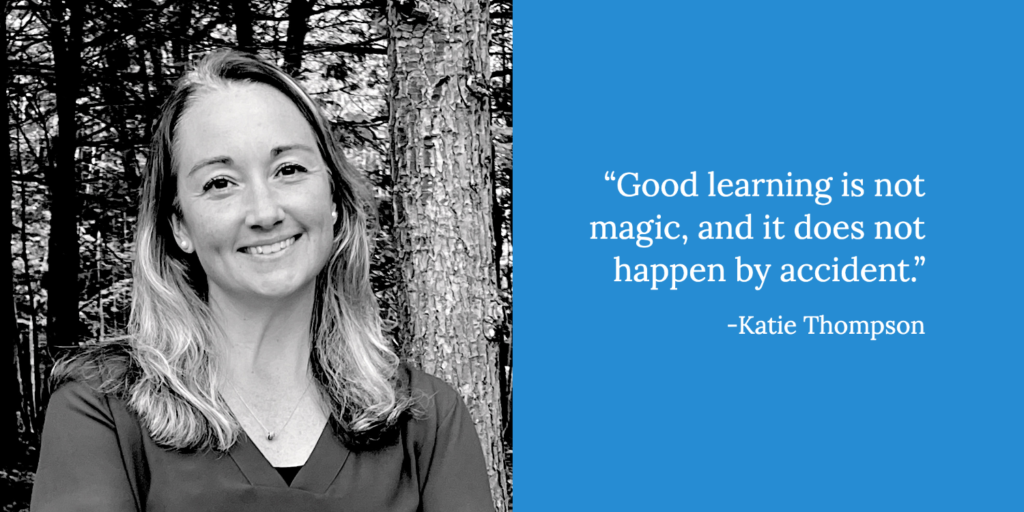
Please read our organizational announcement introducing our new associate directors. Then, check out the interview below to discover more about Katie Thompson, our new Associate Director of Learning and Strategy.
Tell us a little about yourself.
I’m a lifelong Mainer, outdoor enthusiast, road-tripper, and dog mom. I’ve spent the last two decades teaching, coaching, and learning from and with educators and students across New England and beyond. As a student, a teacher, and an athletic coach, I grew to learn that the most meaningful educational experiences are immersive and learner-driven; they make you ask questions and question assumptions. They also allow for trial and error, and multiple paths to problem-solving. As a coach at the Great Schools Partnership, I’ve worked with teachers in schools that exude a passion for their craft and with administrators who have taught me the importance of relationships and community building. When I look back on what brought me to GSP, there isn’t one particular thing I can point to, but I do know what has kept me here for more than eight years: Our mission to change the face of public education and to continue supporting educators to create equitable schools for our students.
What drew you to education and what principles guide you as an educator?
My first job in education was working at a recreation department during the summer while in high school. At the time, I didn’t know I wanted to be a teacher, but the job allowed me to be outside most days and take occasional trips to beaches and amusement parks, so it seemed like a pretty good deal. The goal was to keep elementary and middle school kids engaged and give them a positive experience over the summer when school was out of session. It was almost always challenging, and almost always fulfilling, and started me on my path to becoming an educator.
Although this was not an academic program, the learning that happened at summer rec was no less important. I realized that many kids had excitement and curiosity for nature. We would go on scavenger hunts in the forest, make different types of bird feeders to see what we could attract (turns out, mostly squirrels), and flip over rocks to see what we could find underneath. I learned that getting to know each child and providing them with choice in activities allowed them to explore their passions. Whether it was creating crafts with clay and beads, writing or acting in a play, or organizing and competing in a kickball tournament, most kids were excited to come each day to interact with their peers and the counselors and to continue working on a project, or to try something new. Activities were inclusive and we found a way to incorporate anyone into the activity at any time. We had to be flexible, make adjustments to meet the needs of different students each day, and most of all, we had to make it fun!
Looking back now, the kids were learning about and demonstrating many transferable skills—communication, collaboration, creativity, initiative, persistence, teamwork, and more. These skills, I’ve learned, really are the most essential things that our students need to be successful in our world. As I grew up and realized that teaching was my calling, I continued to carry with me the lessons I learned in the summer rec program: provide choice, include everyone, interact with nature whenever possible, focus on the important stuff (like transferable skills), and make it fun!
Before you were a coach at the Great Schools Partnership, you were a science teacher and athletic coach. How do those experiences inform your work?
As a high school science teacher and athletic coach, I used some of the lessons learned from summer rec, and continued to add to my toolbox. My mission was to provide the best educational experiences for each and every student in my classroom, and to ensure that I fostered a positive relationship with each student. I gravitated toward science because of my own love for the outdoors, but also found that there is a place for everyone in nature. All students can ask questions about what they are seeing, hearing, or experiencing, and each student has something they can share or teach others about the world around them. Outside of the four walls of the classroom, students learn new things about people, so I tried whenever possible to expand our classroom to include the community and the land around us. I learned that these are the experiences that students value and remember. Realizing I could do this work at a larger scale, I committed myself to working with schools across New England as a coach at the Great Schools Partnership.
What do you hope to achieve in your new role?
Working at the Great Schools Partnership over the last eight years has been a highlight of my career in education. I’m overjoyed to be able to grow into a new role here as the Associate Director of Learning and Strategy. I’ve had the opportunity to work with amazing colleagues and learn from innovative educators from across the country. As a school coach, I’ve had the great fortune of working in schools committed to meeting the needs of all students and thinking outside the box to redesign systems and structures with the goal of improving educational equity. While this can be complex and technical work, the ultimate goal of our work is to ignite the passion and joy in learning for both students and educators.
Good learning is not magic, and it does not happen by accident. Through thoughtful planning and collaboration can come the most engaging learning experiences, where students and educators are invested and feel ownership and belonging. In my role as co-director of coaching at GSP, I have been able to collaborate with my coaching colleagues to generate solutions to complex educational challenges and have rich conversations about what equity looks like, sounds like, and feels like in schools. While our work in schools has always been focused on educational equity, I believe we have just begun to scratch the surface of our potential to change the inequitable systems, structures, and practices in public education. Over the last decade plus, we’ve seen schools work to personalize learning, build competency-based systems, and improve educational opportunities for historically marginalized students. I’m looking forward to building on these efforts, and to working across schools, states, and organizations to reimagine what learning and education look like in the next decade.