
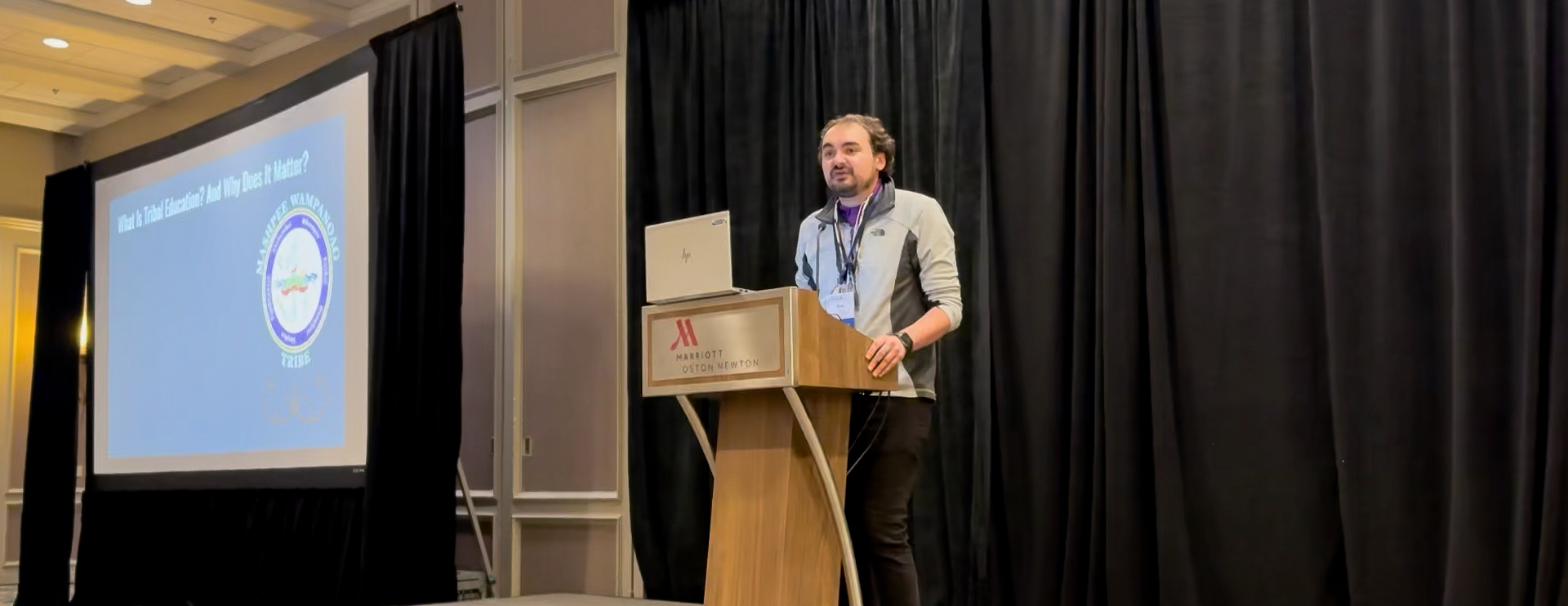
Exploring the importance of indigenous-led education by Aquinnah Wampanoag citizen Brad Lopes (pictured above).
For over 10,000 years, community-centered and culturally aligned education systems existed across Turtle Island, otherwise known as North America. From one Indigenous community to another, children experienced the transfer of knowledge by their elders and knowledge keepers in a system of education that was built around experiential learning, intergenerational interaction, storytelling, and land and water based relationships. This was one social system that has been deeply impacted by the process of settler colonialism, an ongoing process intended to remove and replace the original peoples of these lands and waterways. This disruption in self-determination by Tribal Nations around education and many other areas of sovereignty has posed a significant challenge to Indigenous communities and children.
Educational Challenges in Current Systems
As scholar Natalee Kēhaulani Bauer (Kanaka ‘Ōiwi) put it in her work Tender Violence in US Schools: Benevolent Whiteness and the Dangers of Heroic White Womanhood, why were Indigenous and Black educational systems targeted and replaced in areas that experience settler colonialism? This question lies at the crux of reality for many Indigenous communities who often experience culturally misaligned educational journeys in schools in the United States and other settler colonies. This experience is layered with frequent overt and subliminal moments of racism, prejudice, and hate in their education. This has become such a prominent feature that scholar Leilani Sabzalian (Alutiiq) in her work Indigenous Children’s Survivance in Public Schools stated that “Racial and colonial microaggressions, though often jarring in the moment, are a familiar feature of Indigenous students’ educational experiences, and accumulate as an expected part of school and classroom climates.” With U.S. school systems being deeply colonial in their structure, they often lead to learning environments that prove to be uncomfortable and, at times, harmful to students who do not belong to the dominant cultural groups within this space.
Additionally, with the focus on reading and math literacy, as well as STEAM in general, in the United States, there has been a lack of opportunities for all students to learn and develop cultural literacy skills. Without these skills, students struggle to better understand their own identity and culture, as well as how to interact with and learn from those from other cultural backgrounds. For Indigenous students and staff, this is evident from our earliest days in schools, with many of our peers, teachers, and colleagues having only a rudimentary understanding of us. At times, this is further complicated by attitudes and perceptions that align with stereotypes and tropes that have little connection to reality. These gaps are inherently a product of settler colonialism and a school system that centers colonial understandings of Indigenous people, from our very identities to our continued existence in our ancestral homelands. But, what if it were different? What if Indigenous students experienced culturally aligned education in U.S. schools? What if more resources were invested in Indigenous-led schools and educational programming?
Culturally Responsive Education Benefits All Students
By employing a technique titled Disruptive Daydreaming, coined by Susan Dion from the Lenape and Potawotami Nations, and examining what is or has already been done in other areas of Turtle Island, we can begin to explore these questions. A world where Indigenous students and Tribal Nations have more self-determination over our children’s education is not only possible, it is already here for many communities. In Elsipogtog, a Mi’kmaw First Nation in what is now called Canada, the Tribe has control over their own school and is the predominant decision maker in their children’s educational experience. When one enters their school, they’re immersed in not only Mi’kmaw culture, but the language as well. You’ll see Indigenous pedagogy used throughout, and students leave the school with not only the skills needed to be successful in a Western-dominated hegemony but also the cultural skills and confidence to carry forward Mi’kmaw culture into perpetuity. In the United States, many Tribal Nations out west also maintain control over some aspect of their students’ educational experience, with many students later electing to go to a Tribally operated college such as Haskell University. In these circumstances, education aligns with cultural values and traditions, and oftentimes significant resources are being put into these efforts, from both the Tribal communities and the federal entities that uphold, at times, the responsibilities of their governments to Tribal Nations.
Culturally responsive education for all students is possible, and should be something we pursue heavily across Turtle Island, with Tribal Nations being the key decision makers in this process. By investing in and supporting these efforts, it is also possible to further build cultural literacy skills amongst all students and build effective cross-cultural understandings for students and communities. Many non-Native students, especially on the east coast of what is now called the United States, tend to have skewed understandings of Indigenous people and would greatly benefit from culturally responsive and aligned educational experiences that would act as mirrors for Indigenous students and windows for them. In turn, Indigenous students would have their own cultural values centered in all or some of their educational experiences, leading to a much more rewarding and enriching experience. As sovereign nations, we have a responsibility and right to educate our children how we see fit, and it is long overdue for our sovereignty in education to be fully understood, honored, and supported.
Indigenous Representation in the Educator Workforce
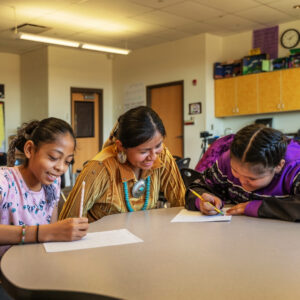
In turn, it is critical that Tribal Nations be represented in the teaching and administration workforce. Due to low staff numbers, students rarely have the experience of having an Indigenous teacher, administrator, or staff member. This is largely due to a lack of structural access and misaligned cultural experiences while going through school. The impact this lack of representation has on both Indigenous and non-Indigenous students is profound. I have witnessed this firsthand in my own experiences as a High School Social Studies Teacher. Although I was teaching in Wabanaki Homelands, I found that I was often the only Indigenous person my students had met and worked with. In many ways, students were able to bridge gaps in their understanding in key ways, build cultural literacy skills, and for one student from the Penobscot Nation, they did not have to feel alone or isolated in that setting. As Indigenous people, we are typically the least represented in children’s educational experience, and it is time we began understanding the reasons why and working toward solutions.
This is one of the key reasons why efforts like the Native American Teacher Retention Initiative (NATRI), funded by the Office of Indian Education (OIE, are critical. Through NATRI, Tribal Nations and organizations have been able to recruit and retain Indigenous teachers and school staff within their communities. The Mashpee Wampanoag Education Department was awarded this grant in 2023, as the only tribal entity east of the Mississippi River. In the short time we have had this opportunity, we have been able to form a cohort of 14 Indigenous educators in a state that reported having only 129 for the 2024-2025 school year. Through this program, we provide the academic, professional, and financial support that is critical to keeping these individuals in the profession. It is our hope to continue to grow the cohort and expand our representation in local schools. By doing this, Mashpee Wampanoag and other Indigenous students will have the opportunity to see themselves in their educators.
The Weetumuw School Model
In other areas of Turtle Island, outside of the Dawnland (New England), Tribal Nations have some control and agency over the educational experience their students engage with. This comes primarily in the form of Tribal Schools and Colleges. In these settings, students are truly immersed in their culture and have educational experiences that align with their community’s values and beliefs. For many Indigenous students on the East Coast, this can be a rare experience until the opportunity to attend a Tribal College. In Mashpee, the ancestral home of the Mashpee Wampanoag community, an effort has been undertaken to address this in the form of the Weetumuw School. Currently serving students ages 2.9 to age 9, the Weetumuw School is centered in Wôpessori pedagogy, a careful blend of Montessori and Wampanoag pedagogies. By employing this pedagogy, students are immersed in Wampanoag culture and language from the beginning of their experience. We feel very strongly that this provides the students with a foundation to be successful in how we define student success.
Honoring Tribal Sovereignty in Education
Efforts like the Weetumuw School and others are continuing their journey forward and seeking to grow. As we look ahead to the future, efforts that center Indigenous representation and self-determination in education are critical and are a part of the trust and treaty responsibilities the United States government has to Tribal Nations. By understanding and honoring Tribal Sovereignty, we can all contribute to and work toward a better future for all students. One that is focused on cultural literacy and working toward a shared space together that honors differences. As independent sovereign nations, we have a right to determine the educational future for our children, and by working together in this effort to address what has been mentioned above, we can build a brighter future for all students on Turtle Island.
 About the Author
Brad Lopes, is an enrolled Aquinnah Wampanoag citizen who oversees the Native American Teacher Retention Initiative Program in the Mashpee Wampanoag Education Department, serves as the Education and Outreach Coordinator for the Aquinnah Cultural Center, and was one of the Great Schools Partnership’s 2025 School Redesign in Action Conference Keynote Speakers. With a background in Secondary Education from the University of Maine Farmington and several years of school experience, Lopes endeavors to decolonize learning spaces, practices, and content to support Wampanoag and other Indigenous students, colleagues, and communities. Please enjoy his guest blog on the subject of decolonizing public education.